
Behavior Workshops
Cross-functional sessions that build shared capacity for behavioral systems work.
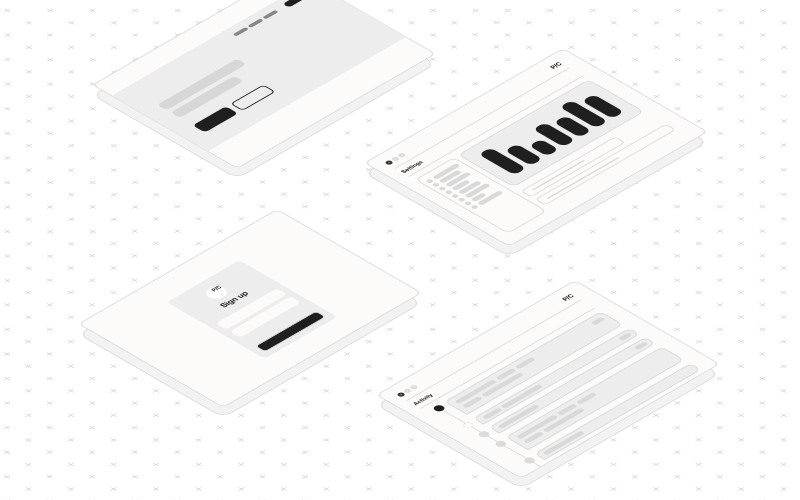
Sessions that build shared capacity, not just shared documents.
Pierce/Co.'s Behavior-Focused Workshops are design sprints and strategy sessions grounded in behavioral systems thinking. They help product, growth, design, and leadership teams rethink how they approach growth — building the shared understanding, language, and capacity that ongoing behavioral systems work requires.
Workshops aren't a standalone discipline at Pierce/Co. They're most valuable as a complement to other engagements — either as a follow-up that helps your team internalize and act on findings from a Behavioral Audit, or as a working layer within a broader Product & Growth Strategy engagement where the team itself needs to rethink how growth gets approached.
Where this fits with the other services.
Workshops are typically paired with other Pierce/Co. work rather than purchased on their own.
- Following a Behavioral Audit. When the Behavioral Audit produces findings that span multiple teams — product, growth, marketing, support — a workshop helps the cross-functional group internalize the findings, build a shared vocabulary for talking about them, and align on which changes will get owned by which teams. The audit produces the diagnosis; the workshop helps the team act on it as a unit rather than as silos.
- Inside a Product & Growth Strategy engagement. When Product & Growth Strategy work surfaces that the team itself needs to rethink how growth gets approached — moving from a campaign-and-experiment model to a behavioral systems model, for example — workshops are the format where that shift happens. The strategy work produces the new approach; the workshop is where the team learns to operate inside it.
- As standalone training, occasionally. Some teams engage Pierce/Co. for workshops without other engagement, usually when there's strong internal alignment on the need for a different approach to growth but no specific audit or strategy work happening. This is the less common use case, and we'll usually recommend pairing with at least a scoped audit to ground the workshop in your business's actual behavioral signal rather than generic frameworks.
Formats we run most often.
Workshops typically run one to three days, depending on the goal and the team size. The formats we run most often:
Shared understanding and aligned KPIs.
Workshops produce shared understanding, aligned KPIs, and team capacity — not shipped artifacts in the same sense as the other engagements. Specifically:
How the engagement runs.
Workshops are scoped and priced as fixed engagements. We work with you in advance to design the session around your specific goal, then run the workshop on-site or remote depending on what works for your team. Most engagements include a brief pre-session conversation and a post-session synthesis.
When workshops are paired with another Pierce/Co. engagement, the scoping happens as part of the broader engagement. When workshops are standalone, the scoping happens in a 30-minute call before the engagement is confirmed.
Teams that need shared understanding.
Cross-functional teams that need to operate from shared understanding rather than parallel sets of assumptions. Most common when:
- A Behavioral Audit has produced findings that span multiple teams and the leadership wants the cross-functional group aligned on action before execution begins
- A product and growth team is shifting how it approaches growth and needs a working session to internalize the new approach
- A leadership team has noticed that product, growth, design, and marketing are optimizing for different behaviors and wants to align around shared outcomes
- A team is preparing to ship a major product or strategic shift and needs to align internally before going to market
This work is less likely to be the right fit if what the team actually needs is more analysis or more strategy rather than shared understanding — workshops can't substitute for diagnostic work that hasn't happened yet.
Questions we get asked.
Turn the diagnosis into shared action.
If your team has the diagnosis or the strategy and what's missing is the shared understanding to act on it, the next step is a short scoping conversation.

A new model for strategic decision making
Four weeks. Transparent pricing. Behavior you can track.

Customer behavior, made undeniable.
Built by Pierce/Co. to stop static deliverables.