
Brand Value Design
Align what your brand promises with what your product delivers.
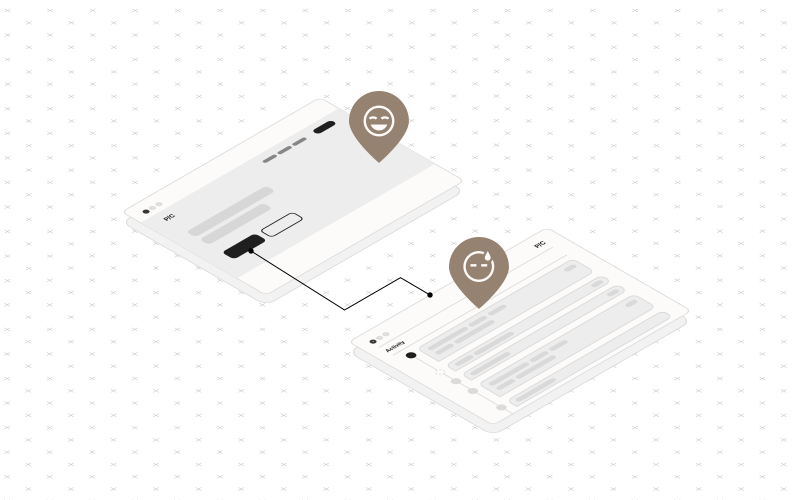
When the brand promises one thing and the product delivers another.
Pierce/Co.'s Brand & Perceived Value Design engagement closes the perception gap — the space between what your brand says you are and what your product proves you are. When that gap exists, customers feel it before they can articulate it. They do the math, conclude you're overpriced, and either negotiate or walk.
This is not a rebrand. It is not visual identity work. It is not a positioning workshop that ends with a new mission statement. It is the structural work of aligning the signals your business is sending — through messaging, positioning, pricing, packaging, and product experience — so that buyers perceive the value you actually deliver.
Where this fits with the Behavioral Audit.
Perceived value misalignment is one of the most common findings from the Behavioral Audit. The audit's nine behavioral dimensions include several that map directly to how value is perceived — trust, fairness, clarity, and others — and when those dimensions score low, the audit will often point at perceived value as the root cause.
When that's the finding, Brand & Perceived Value Design is the engagement that fixes it. The audit identifies where the perception is breaking down and what's producing it. This engagement designs the structural response — the changes to messaging, positioning, pricing, and product experience that close the gap.
You don't have to start with the audit. If you already know perceived value is the problem and you have a clear internal sense of where the gap is, you can engage with Brand & Perceived Value Design directly. But for most teams, starting with the audit produces a tighter engagement — the strategic decisions are grounded in evidence rather than internal opinion, which is especially important for perceived value work because internal opinion about how the brand is perceived is almost always wrong in specific ways.
The changes, not just the recommendations.
A Brand & Perceived Value Design engagement produces the changes — not just the recommendations. Specifically:
The output is the actual changes — copy, packaging, structural interventions — not a document describing what should change. Implementation support is included; we work directly with your team on the rollout.
How the engagement runs.
Brand & Perceived Value Design engagements typically run six to eight weeks. Most engagements follow this shape:
-
Weeks 1–2Evidence and mapping
If you've run a Behavioral Audit, this phase starts with the audit findings and goes deeper on the perceived value dimensions specifically. If you're starting fresh, this phase includes the evidence collection that grounds the engagement — what buyers are actually saying about your value, where the perception is forming, and where the gap is most acute.
-
Weeks 3–5Signal redesign
We design the structural changes. This is the deep work — revised messaging, restructured packaging, intervention design for the product surfaces where the brand promise is breaking down. We work in tight cycles with your team, so the changes land in something your team can ship rather than a deck of recommendations.
-
Weeks 6–8Implementation and validation
We work with your team on the rollout — copy revisions land in production, packaging changes go live, product interventions ship to the relevant surfaces. We define the behavioral signals that will tell you whether the perception is actually shifting (not vanity metrics, but the buyer-side signals that indicate value is being received the way it's now being communicated).
A scoped engagement around a single surface — pricing pages, packaging, a specific product experience moment — typically runs six weeks. A full perception architecture engagement spanning multiple surfaces typically runs eight.
When perception has decoupled from value.
Companies where the perception of value has decoupled from the actual value being delivered — usually because the product has evolved faster than the brand, or because the brand was built around an aspirational story the product hasn't yet caught up to.
Common triggers- Pricing is under pressure that the product quality doesn't warrant
- A competitor with a measurably weaker product is winning deals on perceived value
- The brand reads as "category default" or "generic" despite a genuinely differentiated product
- Customers describe the product in ways that don't match how the brand describes itself
- The sales team is constantly having to "re-explain" what the product is, because the marketing isn't doing the work
- Pricing pages, packaging tiers, or marketing copy were written for a previous version of the product and haven't been updated
This work is less likely to be the right fit if the underlying product genuinely doesn't deliver the value the brand is promising — in that case, the work is product, not perception. We'll tell you that honestly during scoping.
How this differs from brand agency work.
- Not a rebrand. A rebrand changes how you look. This changes how you're understood. The visual identity may or may not change as a result of the work; that's a downstream decision, not the engagement's purpose.
- Not a positioning workshop. Positioning workshops produce a positioning statement and a slide deck of frameworks. This engagement produces the actual revised messaging, packaging, and product interventions that land in production.
- Not brand strategy as conventionally practiced. Conventional brand strategy starts with internal stakeholder interviews, builds a brand framework (purpose, values, personality, voice), and ends with guidelines. We start with how buyers are actually perceiving you in the wild — what they're saying, where the perception is being formed, where the gap is — and design the changes that close the gap. The work is grounded in behavioral evidence, not internal opinion.
- Not naming or visual identity work. Those are valid disciplines but they're not what this is. If naming or visual identity work is what your business needs, a specialist firm in either of those disciplines is a better fit.
The closest analog is what a strong in-house brand strategist working closely with product would do — but scoped as a focused engagement rather than a permanent hire, and grounded in the behavioral evidence layer that most in-house teams don't have time to build.
Questions we get asked.
Close the gap between promise and proof.
If your brand and your product are sending different signals and the cost is showing up in pricing, conversion, or competitive position, the next step is a short scoping conversation.

A new model for strategic decision making
Four weeks. Transparent pricing. Behavior you can track.

Customer behavior, made undeniable.
Built by Pierce/Co. to stop static deliverables.