


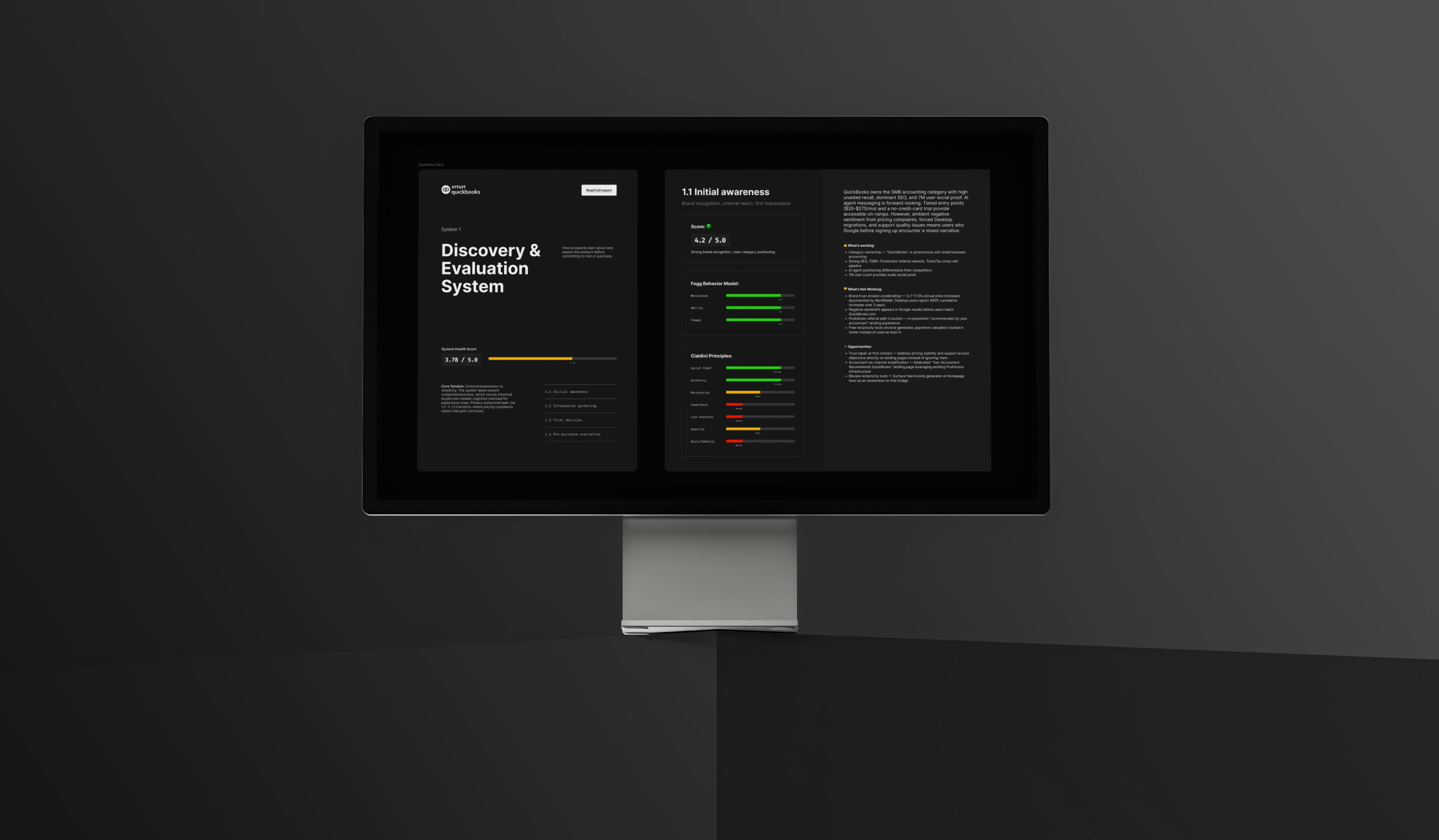
A diagnostic engagement that used buyer psychology to surface why retention had quietly become the most important problem in the business.
In brief. Intuit commissioned a behavioral audit of QuickBooks Online. Working only from public data and two published behavioral frameworks, the engagement surfaced a load-bearing diagnosis, that the product was consuming the trust its expansion revenue depended on, and produced the pattern library, governance artifacts, and leadership brief that translated the diagnosis into a corrective system. The work reframed how the organization read its own retention data.
The approach
Buyer psychology is the lens that makes hidden truths visible in data that's been looked at hundreds of times.
Conversion dashboards, NPS scores, support ticket volumes, and renewal rates all describe what users do. They rarely explain why. Two users can click the same button for opposite reasons. A flat retention curve can hide a system slowly burning down its trust reserves. A rising conversion number can be the early signal of an extraction problem that doesn't show up in revenue for another two quarters. The data isn't wrong, it's just incomplete without a model of the human decisions producing it.
Intuit commissioned a behavioral design audit of QuickBooks Online to apply that lens systematically. The goal was to understand where the product's behavioral systems were working for users, where they were working against them, and where the highest-leverage interventions lived, all grounded in published behavioral science and public signals, with no proprietary methodology and no access to internal analytics. The constraint was the point. If the audit could produce a defensible diagnosis from public data alone, the framework would be portable, reusable by Intuit's teams, by other consultancies, by anyone willing to apply it. That portability is what made it worth doing.
The audit examines every touchpoint in the product through the perspective of the user moving through it: what they want, what they fear, what they understand, what they don't, and what the product is asking them to feel at that moment. Where the perspective produces a clear behavioral diagnosis, that becomes a finding. Where it produces a contradiction with the operational data, that becomes a hypothesis worth testing.
Two published frameworks support the work in the background. BJ Fogg's B=MAP model gives a structured way to ask whether a behavior has the three ingredients it needs to occur, motivation, ability, and a prompt. Cialdini's seven principles of persuasion describe the levers that shift behavior once those ingredients are present. Both are mature, defensible, and widely cited. They earn their place by making the diagnosis legible to people who weren't in the room when it was formed, which is what allows the work to move through an organization.
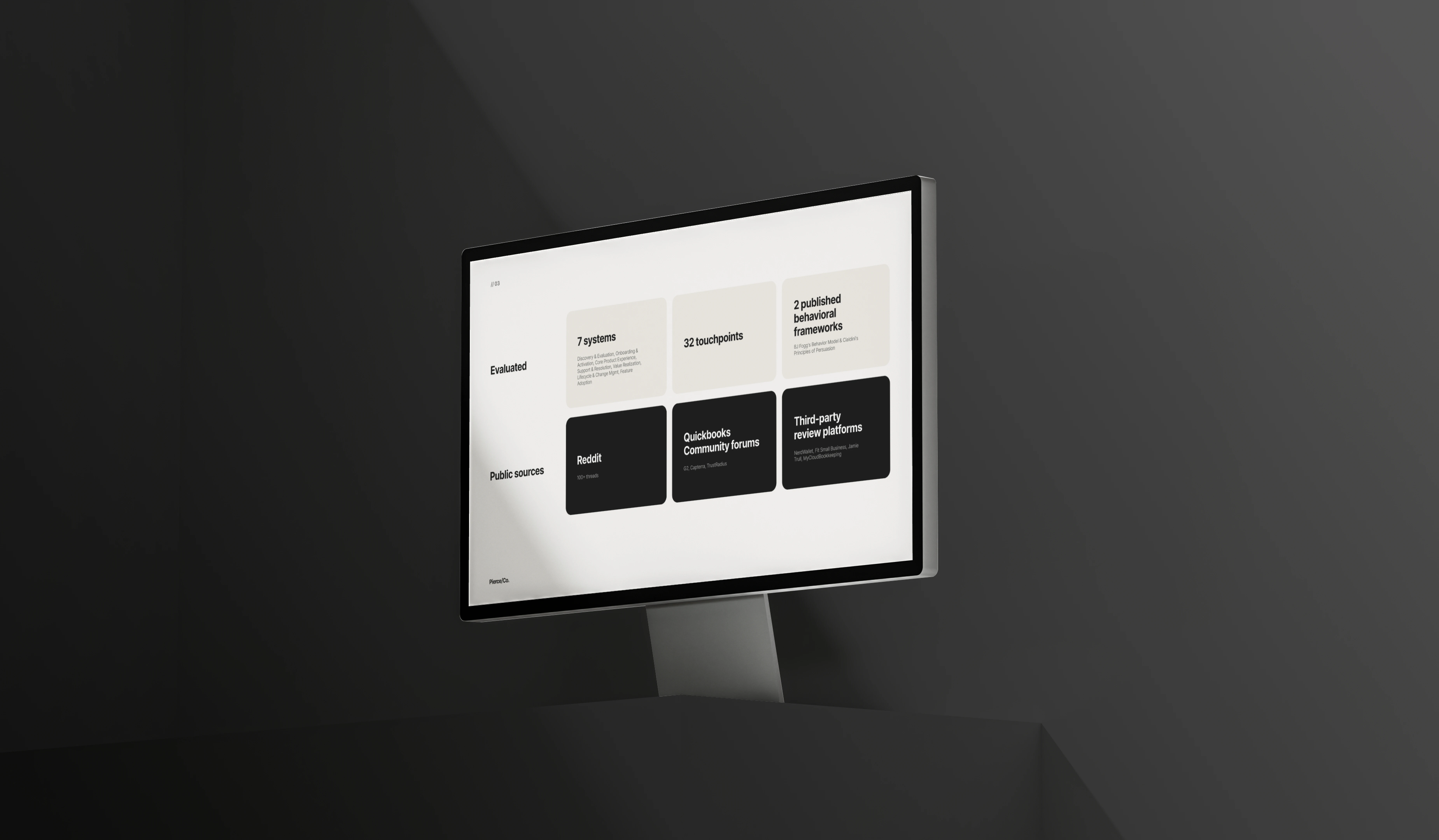
The QuickBooks lifecycle was decomposed into seven systems and 32 touchpoints inside them. Each touchpoint was scored against both frameworks. Sources were exclusively public: the product itself, community forums, Reddit threads, third-party review platforms, and published behavioral research.
What the diagnosis surfaced
The audit converged on a single, load-bearing finding: the product was optimized for extraction, not for the conditions that make extraction sustainable. Trust, value visibility, and signal quality are the infrastructure that expansion revenue depends on, and they were being consumed rather than built.
Four themes carried that diagnosis.
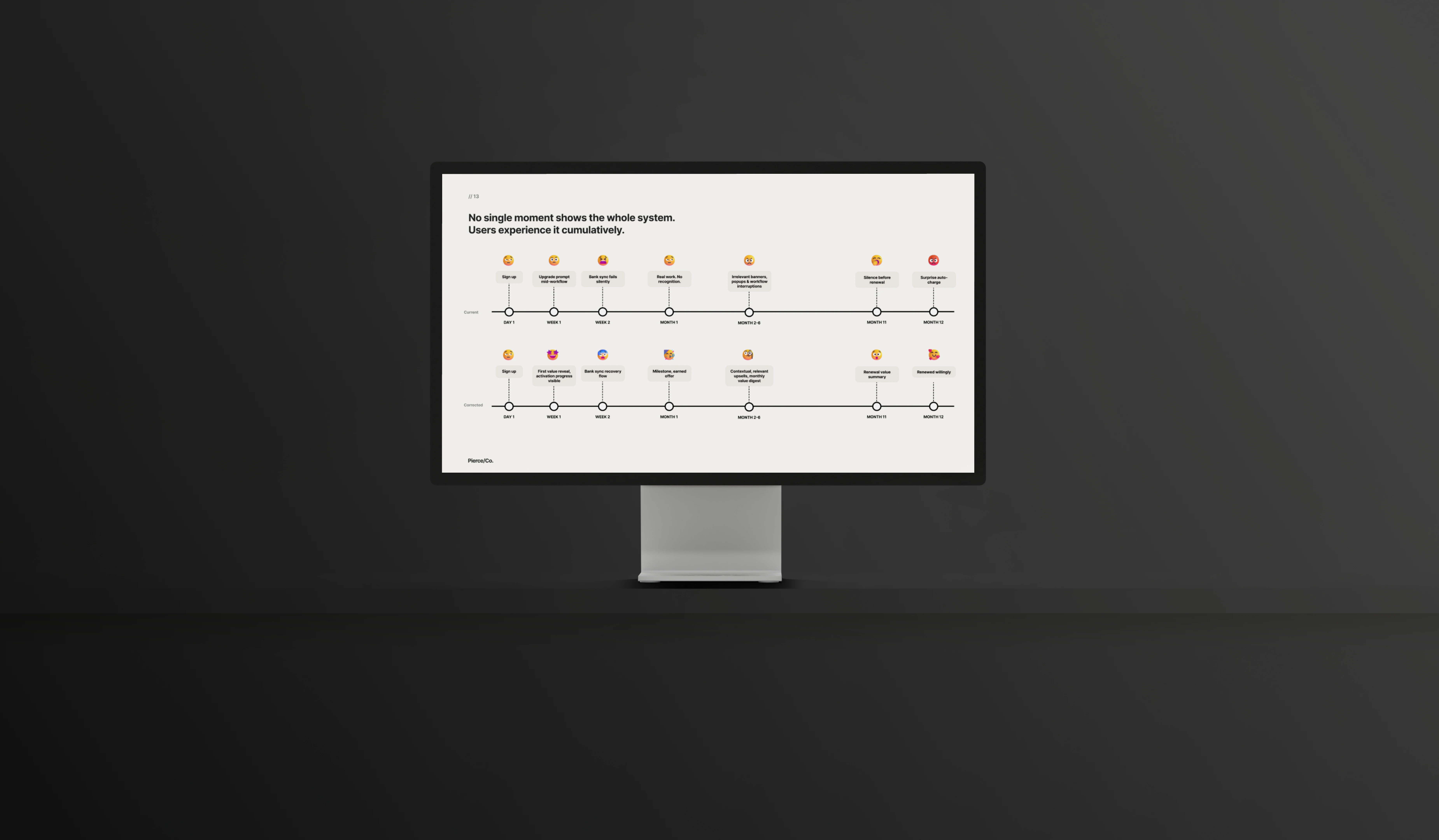
- Value was invisible. The product did significant automated work, categorization, bank sync, tax estimation, and rarely surfaced it. Every renewal became a pure cost decision with no corresponding return in the user's perception. Users couldn't remember the last time the product had done something on their behalf, so the renewal conversation arrived with nothing to weigh the price against.
- Expansion was scheduled rather than earned. Upgrade prompts fired on calendar timing into fragile trust. Maximum pressure landed at the activation window, the moment users were simultaneously most motivated to succeed and most fragile in their commitment. The buyer psychology of that moment is unambiguous: pressure at activation reads as opportunism, not opportunity.
- The communication channel was corroded. Educational content, promotional offers, and system alerts all used identical visual containers. Users couldn't tell them apart, so they stopped reading everything, including the guidance they actually needed. From the user's vantage point, every in-product communication looked the same, which meant every communication got read through the most extractive interpretation available. This was the most consequential structural observation in the audit, and the one that connected the trust erosion across multiple systems into a single explainable pattern.
- The exit door was asymmetric. Upgrades were one click. Downgrades required a phone call. Friction designed to prevent exit was producing the opposite of loyalty, it was producing the kind of resentment users articulate publicly, which then shapes how the next cohort of evaluators perceives the brand before they ever see an ad.
These four themes weren't independent. They formed a causal chain: when value is invisible, expansion has to be scheduled rather than earned; when expansion is scheduled, the communication channel gets used as a marketing surface; when the channel corrodes, the exit becomes the only legible action. Feature adoption, the system where the product is supposed to deepen value over time, emerged as the most behaviorally damaged surface in the lifecycle, and the audit explains why: it sits at the end of a chain of trust erosions that begin much earlier.
That structural framing is what mattered. The individual touchpoint scores confirmed things people had already suspected. The chain, the explanation for why retention was the right place to focus before it was visible in the headline numbers , was the diagnosis the organization didn't already have.
What it produced
The audit became the foundation for a behavioral growth pattern library that translated the diagnosis into specific design patterns mapped to specific lifecycle moments.
It also produced a Standard Discovery Library documenting the governance constraints any individual pattern needs to function, a set of behavioral directives translating the frameworks into operational design rules, and a leadership brief connecting the diagnosis to the business consequences.

What it influenced
The most useful thing the audit did was give people a new way to look at data they were already looking at. Conversion rates, support volumes, and churn signals didn't change. The interpretation of them did. Numbers that had been treated as unrelated started to read as expressions of the same underlying dynamic, which made it possible to argue for interventions that wouldn't have made sense in isolation.
It also gave teams a way to verify hypotheses they'd been carrying without evidence. Several stakeholders had a felt sense that something was off about how the product communicated with users, but didn't have language to describe it or a framework to test it against. The audit produced both, and once the language existed, the hypothesis became falsifiable, which is what allowed it to move from a private intuition into an organizational conversation.
And it raised the bar on what counts as a quality check. After the audit, conversations about new in-product surfaces started including questions that hadn't been part of the previous review process: What is this communication for? Will users be able to distinguish it from a promotional message? What happens to the signal channel if every team ships work like this? Those are governance questions, not design questions, and they're now part of how the work gets evaluated.
Some of the framing absorbed into internal conversation in ways I didn't anticipate. The distinction between three different commercial relationship types, plan upgrades, add-on services, and ecosystem cross-sells, each requiring structurally different treatment, gave people language for a problem they'd noticed but couldn't name. The compounding-strikes framing of churn reframed conversations about how separate user complaints were actually expressions of one underlying pattern. Stakeholders I hadn't met directly cited those framings back to me through other channels. That kind of organic spread is the strongest signal a diagnosis is doing real work.
What I learned
The audit produced fast clarity. Within a few weeks, what had been a diffuse set of concerns about churn, feature adoption, and customer sentiment resolved into a connected diagnosis, a core theme and the specific experiences driving it. That speed-to-clarity is the part I most want to bring to future engagements. The constraint of working only with public data forces a discipline that's easy to lose with internal access: triangulating across the product itself, what users are saying about it, and the third-party services the market has built around it. That triangulation produces the diagnosis faster than internal analytics alone would.
The audit also reframed something I now think is the most important shift behavioral design offers a product organization. Solutions to user problems aren't about giving in to what the customer wants. They're about meeting users in a way that makes them feel seen, understood, and able to predict what the product will do next.
Predictability is the underrated half of trust. Users will accept a lot from a product whose behavior they can anticipate; they will leave one whose behavior surprises them, even when the surprises are individually small.
Most of all, the audit made the case that retention deserved to be a focused area of investment before the trailing metrics confirmed the urgency. Retention failures are slow until they aren't. The behavioral signals, the ones a buyer psychology lens makes visible, show up well before the revenue signals do, which means there's a window where intervention is still possible and inexpensive. That window is what the audit was built to find, and what it found in this case.
This case study is published with the cooperation of the Intuit / QuickBooks team. All evidence cited is drawn from public sources, published behavioral research, and the engagement's public-data methodology.
- Jonathan Pierce, Pierce & Co.
